How to Calculate the Actual Discount Rate of Overseas Products After Applying Coupons, Points, and Member Pricing

Shopping on cross-border e-commerce platforms like AliExpress, Amazon, Rakuten, or Taobao frequently presents buyers with a complex web of promotional incentives. Flash banners loudly advertise "10% VIP Member Price + 20% Store Coupon + $5 Reward Points," tempting shoppers into mathematically adding these percentage numbers together to assume a massive 35% or 40% total discount.
In automated e-commerce environments, however, discount percentages almost never add up linearly. Shopping cart algorithms process promotional benefits through a strict, sequential deduction order. When you factor in category exclusions, non-stackable coupon terms, and hidden foreign exchange (FX) transaction fees, your real out-of-pocket savings are often significantly lower than the advertised percentage. Learning how to calculate your effective discount rate ensures you evaluate cross-border deals with mathematical accuracy.
The mathematical fallacy of adding discount percentages
The most frequent mistake cross-border shoppers make is treating e-commerce discounts as simple additive math. If a platform offers a 10% member price reduction and a 20% store coupon, adding them together (10% + 20% = 30%) assumes that both discounts apply to the original $100 base price.
Automated e-commerce checkout algorithms use sequential discounting instead. The platform applies deductions step-by-step, recalculating the item subtotal after each tier:
- Base Listed Price: The starting public retail price ($100).
- Member/VIP Tier Price: The initial 10% deduction applies to the $100 base price, reducing the subtotal to $90.
- Store or Platform Coupon: The 20% coupon applies only to the reduced $90 subtotal, taking off $18 (not $20). The new subtotal becomes $72.
- Reward Points / Coins: Fixed cash-value points (e.g., $5) are subtracted from the $72 subtotal, bringing the final cost to $67.
Rather than saving 30% ($30 off
100),thecombinedpercentagediscountsactuallyyielda28100),thecombinedpercentagediscountsactuallyyielda2828 off $100). Adding points brings the final cost to $67, representing a 33% effective discount rate—not the 35% or 40% a shopper might have mentally estimated.
Step-by-step formula for calculating the effective discount rate
To find your true out-of-pocket savings on any overseas purchase, ignore the promotional banners and track the exact sequence of deductions using a structured workflow.
Here is a step-by-step calculation breakdown for a $100 item utilizing stacked promotional benefits:
To determine the exact Effective Discount Rate (EDR), apply this simple algebraic formula:
Effective Discount Rate (%)=Original Price−Final Out-of-Pocket CostOriginal Price×100Effective Discount Rate (%)=Original PriceOriginal Price−Final Out-of-Pocket Cost×100Plugging in the numbers from our example table:
Effective Discount Rate (%)=$100−$65$100×100=35%Effective Discount Rate (%)=$100$100−$65×100=35%Despite taking advantage of a 20% VIP price, a $10 coupon, and $5 in points, the true discount rate is 35%—a clear, objective figure that allows you to compare the deal against local retail alternatives accurately.
Stacking restrictions and hidden financial friction
Even after mastering the deduction sequence, hidden fine print and international banking fees can further erode your effective discount.
Coupon terms and non-combinable promotions
E-commerce sellers frequently insert restrictive terms into coupon fine print. A common restriction is the "Non-Combinable" clause. If an item is already marked down via a member sale or flash deal, applying a platform-wide coupon may override the member price entirely, replacing a 20% VIP discount with a 15% coupon discount rather than combining them. Always inspect whether applying a new coupon causes an existing tier discount to disappear from the cart summary.
Currency conversion markup and foreign transaction fees
When buying overseas products listed in foreign currencies (such as USD, JPY, or EUR), your issuing bank and credit card network apply financial friction that reduces your net savings:
- Foreign Transaction Fees: Most standard credit cards charge a 1% to 3% fee on international transactions. A $3 savings from a coupon can be instantly wiped out if your card charges a 3% international processing fee on a large order.
- Dynamic Currency Conversion (DCC) Traps: At checkout, some foreign sites offer to charge your card directly in your local home currency. This service applies an inflated exchange rate that includes a 3% to 5% hidden conversion markup.
Pre-checkout verification and shopping cart previews
To protect your wallet from false savings claims, establish a rigorous pre-checkout audit routine.
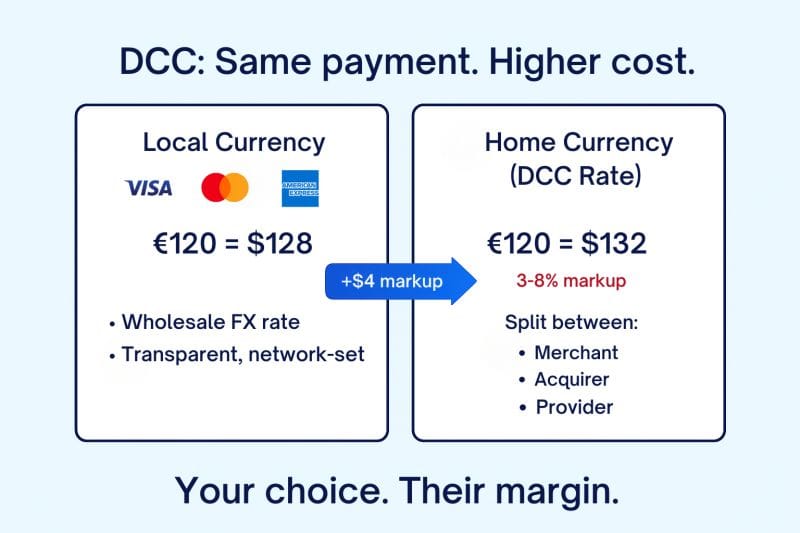
Visa guidance listing the exchange rate, both currency amounts, and additional markup required for Dynamic Currency ConversionCart simulation without submitting payment
Never estimate your final cost from the product detail page. Always add the item to your shopping cart and proceed to the final checkout preview screen (without clicking "Submit Order").
The checkout preview forces the server's algorithm to calculate all active rules, displaying a line-item breakdown of the original item cost, stacked coupon deductions, point redemptions, regional taxes, and international shipping fees.
Inflated retail prices and historical price baselines
Marketplace sellers often engage in artificial price inflation prior to major global shopping events (like Black Friday or 11.11 Single's Day). A seller might raise an item's listed "Original Price" from $100 to $140, then offer a "30% off coupon."
Applying a 30% coupon to an inflated $140 price brings the final cost to $98—yielding a true savings of just $2 off the historical $100 baseline price, despite the banner claiming a massive 30% discount. Always use price-history tracker tools to verify the historical baseline price before trusting displayed discount percentages.